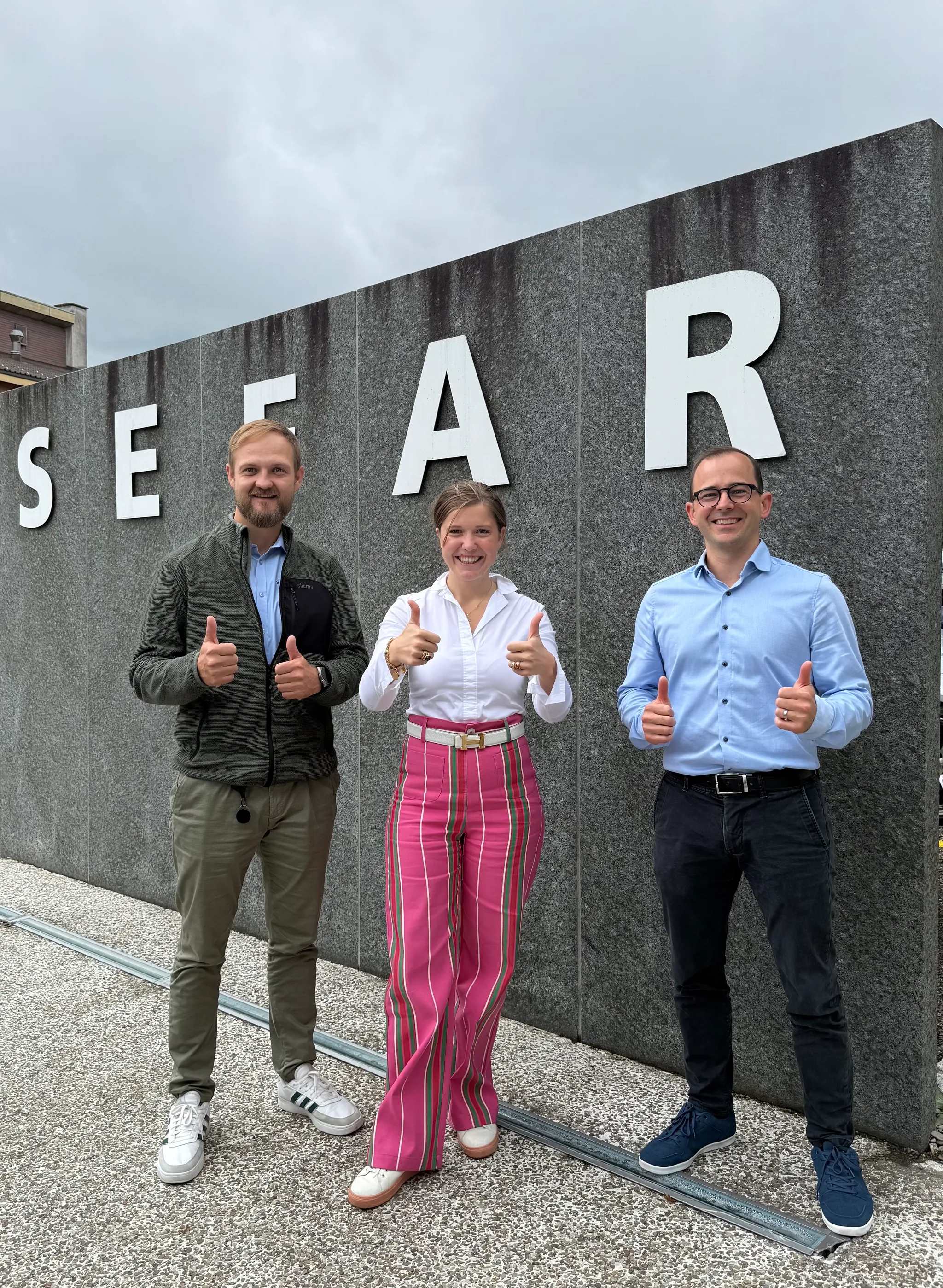
The journey to Sefar's headquarters in Heiden, Switzerland, takes you through winding roads, green hills, and stunning views of Lake Constance. At the top, a sleek glass building welcomes visitors. Inside, a corridor lined with display cases showcases technical fabrics used in filters, grain mills, or cars. "This is all Sefar," says Reto Hegelbach, his eyes lighting up. "And most of it, you don’t even notice in daily life. But it makes a difference."
What Sefar produces is quite literally woven into our lives. Scientific precision meets practical application in a way that makes innovation tangible, visible, and useful.
A Hidden Champion from Eastern Switzerland
So, what exactly does Sefar do? The company develops highly specialized fabrics that filter, separate, conduct, dampen, or distribute. These fabrics are so fine-tuned and application-specific that they can remove pollutants from liquids in biotech systems or evenly distribute light in car displays.
Sefar controls the entire innovation chain: from yarn production to weaving, all the way to the development of complex applications. "Our products are often invisible, but they are essential," says Hegelbach. With around 3,000 employees and annual revenues of approximately CHF 367 million, Sefar is globally positioned but deeply rooted in the region.
Reto Hegelbach has been with the company since 2008. After roles in production, process development, and smart fabrics, he now leads the innovation division. For him, innovation management means more than launching new products; it's about anticipating trends, navigating regulations, and strategically combining existing capabilities.
"We currently manage about 80 development projects simultaneously," he says.
Marko Draguljic, who joined Sefar in 2021, is equally immersed in the company. As Head of Learning & Development, he oversees employee development, coordinates internships, theses, and learning formats. His goal: "We want to develop people who can thrive in a global, innovative environment."
Innovation Management and Intellectual Property
"Innovation management doesn't mean just having a good idea and hoping it works," says Hegelbach. "It means thinking strategically, working across disciplines, and anticipating trends like sustainability, compliance, and functional integration early on."
His department rests on three pillars: project management for over 80 ongoing development projects, intellectual property (IP) management, and the identification of new innovation fields. One cornerstone is protecting intellectual property. "Patent management is not an afterthought for us; it’s a strategic compass," Hegelbach explains. Collaborating with universities requires early clarity: Who owns what? How transparent can we be? What can be published?
Clear IP regulations not only offer security, they make collaboration smoother. "If we see a competitor citing one of our patents, we know we’re on the right track," he says. Patent data analysis also helps Sefar anticipate market trends and serves as inspiration for new projects.
University Collaboration
Working with universities is part of Sefar's DNA, from joint research projects with Empa to advisory roles on academic boards. "We benefit the most when projects are practically relevant and methodologically sound," says Hegelbach.
But not all collaborations make sense. "We have to choose strategically. You can’t work with everyone," he says. Besides the topic, team compatibility and openness to industrial processes are key – including standards, timelines, and commercialization goals.
His wish: "Lower the entry barriers. Not every collaboration should require a full legal apparatus."
Bureaucracy shouldn't kill great ideas, because that hurts not only the company but also the university and, ultimately, Switzerland as an innovation hub.
Fostering Talent with Studyond
Draguljic doesn’t see universities as distant ivory towers but as breeding grounds for relevant talent. As Head of Learning & Development, he creates formats where science and practice converge directly. Thesis projects are particularly important to him. "They’re a win-win," he says. "Students tackle real-world challenges. We gain fresh perspectives and impulses."
He speaks from experience: he wrote his own Master’s thesis at an industrial company, balancing academic rigor with business impact.
“I wrote 270 pages, but condensing everything into a single PowerPoint slide for management in the end, that was the biggest challenge.”
To make a thesis successful, alignment is key. "Students, universities, and companies often have different expectations. The earlier you clarify them, the better the outcome." Project management, stakeholder communication, and realistic timelines are just as important as the content.
Failure is also part of the process. "Not every project will succeed, but even that is a valuable experience."
Conclusion: Low Entry Barriers
How can universities and companies collaborate more effectively? For Hegelbach and Draguljic, it comes down to open, structured dialogue: practitioners as guest lecturers, real-world problems in seminars, and collaboration formats that don’t drown in red tape.
Their advice for students: Plan ahead. Identify your stakeholders. Align expectations. And above all, stay curious. Because writing a thesis at Sefar means becoming part of an innovation system that works every day to make the world more efficient, safer, and more sustainable.
A visit to Heiden proves: Innovation gets under your skin or better yet, into the fabric.