Where Science Meets the World
CERN – the European Organization for Nuclear Research – is a place of extremes: straddling the Swiss-French border, over 100 nationalities, cutting‑edge research into the origin and structure of the universe. And: a remarkable infrastructure for education, talent development, and collaboration. Research at CERN is never a solo endeavor.
In addition to about 2,700 staff members, thousands of students, doctoral candidates, and interns work here each year in Geneva. Many stay; some for life. The sprawling site – labs, workshops, offices, and visitor centers – is a meeting ground where engineering and science meet curiosity, expertise meets openness.
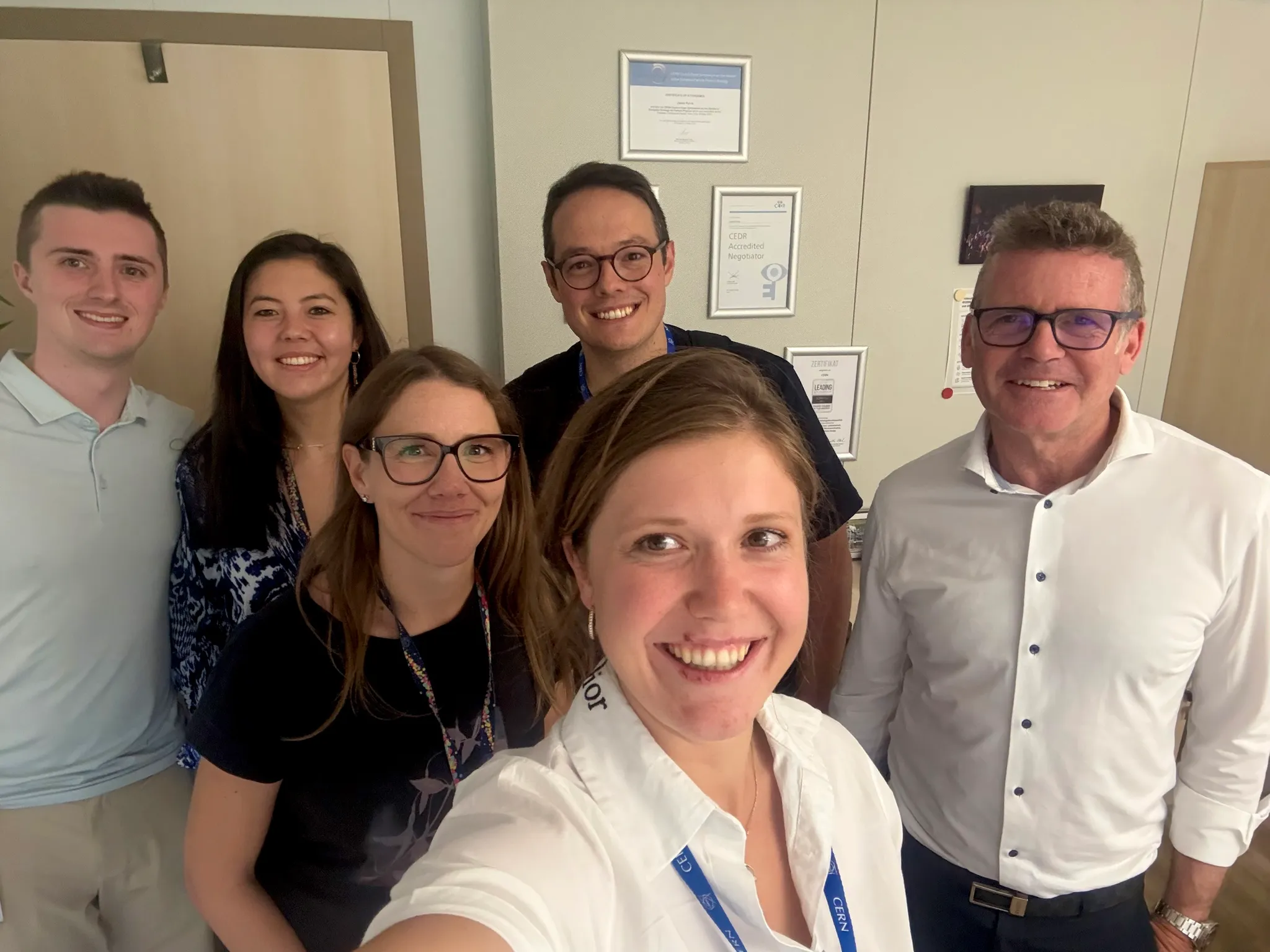
We visited and interviewed four people who live that diversity.
Shaping Diversity: HR Work at CERN
Sabrina Holthausen and Flavia Düsselberg work in CERN’s Talent Acquisition team, an area where employer branding is not just a theoretical concept but visible in every email and at every event. Among other things, both are responsible for coordinating outreach activities in Germany and the Netherlands, including partnerships with universities (of applied sciences), to raise early awareness among young talent of the diverse career opportunities at CERN, engage them (and in some cases shape an entire professional journey).
“Many people think they’re not good enough for CERN,” says Holthausen. “But we’re not looking for the perfect résumé. We look for people with curiosity and courage.”
The goal: show career paths before they’re fixed. Through internships, summer schools, or thesis opportunities, CERN offers entry points that often smoothly transition into doctoral programs or permanent roles. The emphasis is not only on high-level research, but on encounter and guidance. Holthausen shares the story of a talent who, after an internship, wrote their Master’s thesis at CERN, returned as a research fellow, and now leads projects: “If someone gets a start with us, they often come back.”
Düsselberg understands the challenges from the other side: “The academic landscape is very fragmented. There are many actors, but often no central contact persons.” Her approach: building relationships, staying present, listening. Whether at career fairs, info sessions, or roadshows.
“We offer formats for different stages of study,” Düsselberg explains. “What matters is that students feel seen and understand that CERN isn’t a closed world.”
Although theses are not always formally advertised, they are often part of larger programs. “A thesis is often the first touchpoint. It bridges university and practice – and shows how multifaceted research can be,” says Holthausen. “Those who stay are the ones who ask questions, take initiative, show themselves.” Entry often begins with a conversation and the openness to try something new.
Between Engineering and Team Spirit: Working in Beam Instrumentation
Jean Michel Meyer is a Senior Electronics Technician in the Beam Instrumentation Group. Together with his team, he ensures that scientific operations run smoothly throughout CERN’s entire accelerator complex. It’s a job with major responsibility: “In the LHC alone, around 3,800 sensors in the form of ionization chambers are installed. Most of them are connected to the interlock system. If one fails, operations come to a halt.”
One assignment in the SPS accelerator left a particularly strong impression: “Because of the high radiation levels, each team member was allowed to work at the intervention site for only two minutes. Every single step had been planned in detail beforehand - without perfect communication and coordination within the team, it would not have been possible.”
In addition to his technical responsibilities, Meyer is also active in outreach, for example by giving guided tours to visitors: “On peak days, up to 4,000 people visit CERN. I love sharing my enthusiasm, including with a bit of Rhineland openness.” One question he is asked particularly often is what a typical workday looks like. “Most people don’t realize how essential technical professions are to research. CERN is like a high-speed highway for particles, and we monitor whether any problems arise along the way.”
His message to young people: “Take opportunities while you have them. Step out of your comfort zone. It’s worth it!”
Experiencing Fundamental Research: Montague King in the PhD Program
Montague King is pursuing his PhD at the University of Liverpool, while doing research at CERN in the Beam Instrumentation Group. His topic: beam-loss monitors – systems that warn when the particle beam loses particles. “We are like a sensor system that raises alarms before something breaks.”
What excites him is the blend of theory and application. In addition to data analysis, he’s helped design detectors, attended conferences in Beijing and Liverpool, and toured all CERN accelerators. “Research means having a problem and finding a solution – whether it’s basic science or applied.” He values the open exchange:
“The cafeteria is like a mini-United Nations. You learn so much from each other.”
To universities he offers a wish: more real projects, fewer purely theoretical essays. Theses should read like scientific papers – “not like encyclopedias.”
His advice to students: “Many hesitate to ask or to apply. But that’s exactly what’s needed: show interest and take a chance.”
Outlook: Theses as Bridges to Practice
What unites all four participants is their belief in curiosity, access, and encounter. Whether in HR, engineering, or research — they want young people to take their curiosity seriously and make their work visible.
Theses are more than a final act of study: they are door-openers, networking platforms, learning spaces. In an international context like CERN, they link knowledge production with intercultural experience — and often a job opportunity.
The call to universities is clear: more cooperation, more courage, more practical relevance. Or as Montague King puts it: “If you don’t apply, you’re already rejected.”
